 THE UNIVERSITY OF CHICAGO

Princeton University, PhD '92
BIOGRAPHY
I have spent most of my intellectual life shuttling between the micro and the macro, trying to understand how life and ideas shape and are shaped by each other. One stream of my work has approached these questions through religion, focusing on the ways in which Jewish, Christian, and Islamic cultures constitute themselves by interrelating with or thinking about each other. My first book, Communities of Violence: Persecution of Minorities in the Middle Ages, studied social interaction between the three groups within the context of Spain and France in order to understand the role of violence in shaping the possibilities for coexistence. In later projects I explored the work that “Judaism,” “Christianity,” and “Islam” do as figures in each other’s thought. One product of that approach, focused on art history, was (jointly with Herb Kessler) Judaism and Christian Art: Aesthetic Anxieties from the Catacombs to Colonialism (2011). In Anti-Judaism: The Western Tradition (2013), I attempted to apply the methodology to a very longue durée, studying the work done by pagan, Christian, Muslim, and secular thinking about Jews and Judaism in the history of ideas. More or less simultaneously in Neighboring Faiths: Christianity, Islam, and Judaism Medieval and Modern (2014), I tried to bring the social into conversation with the hermeneutic, in order to show how, in multireligious societies, interactions between lived experiences and conceptual categories shape how adherents of all three religions perceive themselves and each other. Then in Aesthetic Theology and Its Enemies: Judaism in Christian Painting, Poetry, and Politics (2015), I focused on how thinking about Judaism shaped the ways in which Christian cultures could imagine the possibilities and limits of community and communication.
Beginning with my book Anti-Judaism, which stretched from ancient Egypt to the twentieth century in order to try to understand the work done by a family of concepts across history, I have tried to cultivate a new approach to the “long history” of ideas. My most recent book, Uncountable: A Philosophical History of Number and Humanity from Antiquity to the Present, written in collaboration with Ricardo Nirenberg (a mathematician who happens also to be my father), follows this path as well. It explores the long history of the various types of sameness that underpin the claims of different forms of knowledge (from poetry and dreams, to monotheism, math, and physics), using these to think critically about the powers and the limits of the sciences and the humanities. I am now at work on the long history of yet another family of concepts, namely the inter-connected history of race and religion from the Neolithic to the present.
Recent Research / Recent Publications
Coauthored with Ricardo Nirenberg. Uncountable: A Philosophical History of Number and Humanity from Antiquity to the Present. Chicago, IL: University of Chicago Press, 2021.
Communities of Violence: Persecution of Minorities in the Middle Ages. Princeton, NJ: Princeton University Press, twentieth-anniversary edition with new preface, 2016.
Aesthetic Theology and Its Enemies: Judaism in Christian Painting, Poetry, and Politics. Lebanon, NH: University Press of New England, 2015.
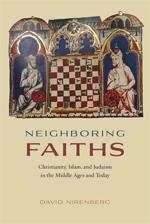
Neighboring Faiths: Christianity, Islam, and Judaism in the Middle Ages and Today. Chicago, IL: University of Chicago Press, 2014.
- Review of Neighboring Faiths and Anti-Judaism by Carlos Fraenkel, "We Hear and We Disobey," London Review of Books (May 21, 2015): 31–34.
Anti-Judaism: The Western Tradition. New York: W.W. Norton, 2013.
- Review by Michael Walzer, "Imaginary Jews," New York Review of Books (Mar. 20, 2014)
- Review by Anthony Grafton, "The Strange History of Antisemitism in Western Culture," New Republic (Oct. 11, 2013)
Discusses book on US Holocaust Memorial Museum podcast
Awarded Ralph Waldo Emerson Award
Communities of Violence: Persecution of Minorities in the Middle Ages. Princeton, NJ: Princeton University Press, 1996; paperback edition, 1998. Spanish translation: Comunidades de Violencia: Persecución de minorías en la edad media. Peninsula Editorial, 2001; French translation: Violence et minorités au Moyen Age. Paris: Presses Universitaires de France, 2001.
- 2000 John Nicholas Brown Prize, Medieval Academy of America
- 1998 Herbert Baxter Adams Prize, American Historical Association
- 1998 Best First Book in Iberian History, Society for Spanish and Portuguese Historical Studies
- 1996 Premio del Rey Prize, American Historical Association
- Coedited with María Elena Martínez and Max Hering Torres. Race and Blood in Spain and Colonial Latin America. LIT-Verlag, 2012.
- Coedited with Herbert Kessler. Judaism and Christian Art: Aesthetic Anxieties from the Catacombs to Colonialism. Philadelphia: University of Pennsylvania Press, 2011.
- "The Impresarios of Trent: The Long and Frightening History of the Blood Libel." Nation (November 16, 2020).
- "What Is Islam? (What Is Christianity? What Is Judaism?)." Raritan 35 (Fall 2016): 1–14.
- "Love." In What Reason Promises: Essays on Reason, Nature, and History, edited by Wendy Doniger, Peter Galison, and Susan Neiman, 46–54. Berlin: De Gruyter, 2016.
- With Leonardo Capezzone. "Religions of Love: Judaism, Christianity, Islam." In The Oxford Handbook of the Abrahamic Religions, edited by Adam Silverstein and Guy G. Stroumsa, 518–535. Oxford: Oxford University Press, 2015.
- "Power and Piety: Is the Promotion of Violence Inherent to Any Religion?" Nation (Apr. 29, 2015).
- "Posthumous Love in Judaism." In Love After Death: Concepts of Posthumous Love in Medieval and Early Modern Europe, edited by Bernhard Jussen and Ramie Targoff, 55–70. Berlin: De Gruyter, 2015.
- "'Judaism' as Political Concept: Toward a Critique of Political Theology." Representations 128 (Fall 2014): 1–29.
- "'Judaism,' 'Islam,' and the Dangers of Knowledge in Christian Culture, with Special Attention to the Case of King Alfonso X, 'the Wise,' of Castile." In Mapping Knowledge: Cross-Pollination in Late Antiquity and the Middle Ages. Arabica Veritas, vol. I, edited by C. Burnett and P. Mantas-España, 253–76. Cordoba: Oriens Academica, 2014.
- "Sibling Rivalries, Scriptural Communities: What Medieval History Can and Cannot Teach Us about Relations between Judaism, Christianity, and Islam." In Faithful Narratives, edited by Andrea Sterk and Nina Caputo, 63–82. Ithaca, NY: Cornell University Press, 2014.
- "Christian Love, Jewish 'Privacy,' and Medieval Kingship." In Center and Periphery: Studies on Power in the Medieval World, edited by Katherine L. Jansen, G. Geltner, and Anne E. Lester, 25–37. Leiden: Brill, 2013.
- Coauthored with Ricardo Nirenberg. "Badiou's Number: A Critique of Mathematical Ontology." Critical Inquiry 37, no. 4 (2011): 583–614. Response by Alain Badiou and a reply by us, "Critical Response." Critical Inquiry 38 (2012): 362–87.
- "From Cairo to Cordoba." Nation (June 1, 2011).
- "When Philosophy Mattered." New Republic (Feb. 3, 2011): 39–43.
- "Shakespeare's Jewish Questions." Renaissance Drama (2010): 77–113.
- "Double Game: Maimonides in his World." London Review of Books (Sept. 23, 2010): 31–32.
- "Anti-Zionist Demography." Dissent (Spr. 2010): 103–9.
- Interviewed on anti-Semitism for The New Yorker, 2020
- Writes op-ed on Facebook's hate speech policy, Tablet Magazine, 2019
- Appointed interim dean of the Divinity School, 2018
- Appointed executive vice provost
- Quoted in an Atlantic article on Charlottesville and anti-Semitism
- Awarded 2017 Historikerpreis der Stadt Münsters for his body of work
- Delivers the University of Chicago 527th Convocation Address [video, 12 minutes]
- Awarded Doctor of Philosophy, Honoris Causa, University of Haifa, 2016
- Elected to the American Academy of Arts and Sciences
- Publishes Aesthetic Theology and Its Enemies: Judaism in Christian Painting, Poetry, and Politics (Brandeis, 2015)
- Delivers 2015 Harper Lecture on Religion and Violence [video, 79 minutes]
- Publishes Neighboring Faiths: Christianity, Islam, and Judaism in the Middle Ages and Today (Chicago, 2014).
- Appointed a Fellow of the Medieval Academy of America
- Appointed Dean of the Social Sciences Division