 THE UNIVERSITY OF CHICAGO

Harvard University, PhD '09
BIOGRAPHY
My research on intellectual history, or the history of ideas, is my way of exploring how history and thought shape each other over time. The Italian Renaissance is a perfect moment for approaching this question because at that point the ideas about science, religion, and the world that had developed in the Middle Ages suddenly met those of the ancient world, reconstructed from rediscovered sources. All at once many beliefs, scientific systems, and perceived worlds clashed, mixed, and produced an unprecedented range of new ideas, which in turn shaped the following centuries and, thereby, our current world.
My latest book Inventing the Renaissance: Myths of a Golden Age (University of Chicago Press USA, Head of Zeus UK) is a popular-facing examination of the history of seeing the Renaissance as a golden age in contrast with the so-called Medieval Dark Ages, where those myths originated and why they have been so hard to eradicate. Using the tools of historiography, crisscrossing interwoven biographies, and narrative storytelling, the book traces both the nineteenth- through twenty-first-century histories of Renaissance studies as a discipline and the Renaissance’s aspirational projects of humanism and the classical revival, juxtaposing details from the lives of Machiavelli and Petrarch with anecdotes from contemporary academic conferences to show how the period is constantly being invented and reinvented. It was named a Best Book of 2025 by The New Yorker and Scientific American.
My current book project focuses on patterns in the history of the real motives of censors over space and time, from antiquity to the digital age, especially the Inquisition and early modern censorship, and 20th century censorship of popular media. The enormous impact of Orwell's Nineteen Eighty-Four has led modern people to imagine censorship working the way his Ministry of Truth does: imposed top-down on a populace, with vast resources, a stable, long-term plan, and the goal of controlling society, stifling thought, and destroying information. But the real actions and records of past censors reveal that the vast majority of real censorship has inverse qualities: shaped by bottom-up social anxiety, constantly desperate for funds and personnel, hastily improvised in response to a perceived crisis, constantly transformed ad hoc as the perceived threat changes, and (from the point of view of the censors) aiming to protect vulnerable individuals, and to encourage self-censorship rather than destroying extant information. Only by examining the real motives which have made people say "Yes" to censorship over space and time can we understand what patterns help it flourish, and ways to combat it. I am especially interested in how innovations in information technology trigger waves of new censorship, a topic I explored in a dialog series and museum exhibit: voices.uchicago.edu/censorship.
As a novelist (science fiction, fantasy, and historical fiction), I am also very interested in how to better connect the worlds of history research and speculative fiction, both to innovate pedagogically, and to help new improved historical narratives and correctives make it into the books, games, and TV which are what shape most people's first impressions of history, but often draw on histories that are more than half a century out of date. My fiction has won major literary awards in France, Poland, and the USA, including the Astounding and Compton Crook awards, and has been a finalist for the Hugo Award. My collection of essays on history and genre fiction, Trace Elements: Conversations on the Project of Science Fiction and Fantasy (Tor Books), several publications on history in SF&F, comics, anime & manga, and am a nonfiction columnist for Strange Horizons. I also employ creative writing, role-playing and LARP in my classes, and work with SFWA (the Science Fiction Writers of America) on helping to connect writers with historians and their research. In my role as a historian/futurist, I consult for several tech companies and activist groups including Github, the X-Prize Fuondation, and am part of the International Workshop on Reimagining Democracy.
I take my mixture of history and storytelling into the classroom. My signature undergraduate course, “Italian Renaissance: Dante, Machiavelli, and the Wars of Popes and Kings” draws on the traditions of live-action role-playing games to create a three-week full-costume historical simulation of the papal election and wars described by Machiavelli in his letters and The Prince. Working via historical immersion, like language immersion, and using the tools of alternate history, the course drops students in the worldview and crises that shaped Machiavelli’s innovative political thought, and culminates with a group reading of The Prince with the unique perspective of having just made the same hard choices Machiavelli’s contemporaries did, and living with the consequences. The course’s unique approach was recently featured in The New York Times. My study abroad program Florence Living with History is a classroom-less course which uses the historic center of Florence as its textbook, visiting historic sites and museums every day for a three week intensive getting to know, both the city’s history, and today’s living city as it struggles to balance the helpful and harmful impacts of the hundreds of thousands of tourists who continue the long tradition of this historic capital which, even 500 years ago, was constantly filled with and economically dependent on a huge population of foreigners (students, pilgrims, merchants) both permanent and transient.
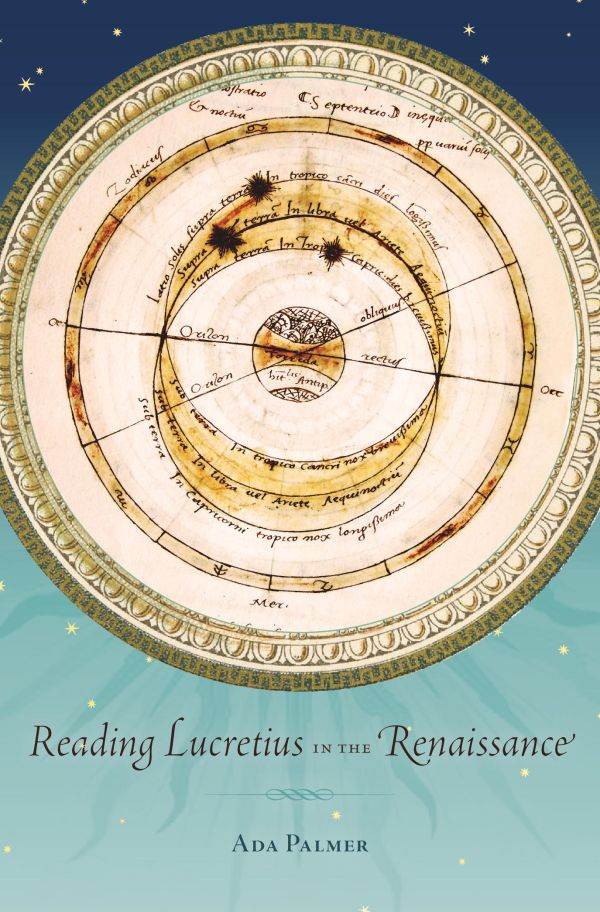
My first scholarly book, Reading Lucretius in the Renaissance, explores scholars' use of Lucretius's Epicurean didactic poem De Rerum Natura from its rediscovery in 1417 to 1600, focusing on the challenges its atomistic physics posed to Christian patterns of thought. In a period when atheism was often considered a sign of madness, the sudden availability of a sophisticated system that explained natural phenomena in nontheistic ways and that argued powerfully against the immortality of the soul, the afterlife, and a creator God threatened to supply the one weapon unbelief had lacked in the Middle Ages: good answers. At the same time, humanist scholars who idealized ancient Rome were eager to study a poem whose language and structure so often anticipated their beloved Aeneid. My book uncovers humanist methods for reconciling Christian and pagan philosophy and shows how atomism and ideas of emergent order and natural selection, so critical to our current thinking, became situated in Europe's intellectual landscape at the beginning of the scientific transformations of the seventeenth century. In it I employ a new quantitative method for analyzing marginalia in manuscripts and printed books, whose results expose how changes in scholarly reading practices over the course of the sixteenth century, fostered by the growth of printing, controlled the circulation of texts and gradually expanded Europe's receptivity to radical science, setting the stage for the scientific revolution.
I also work extensively on classical transformations, i.e., how, thanks to humanist enthusiasm for reconstructing the golden age of ancient Greece and Rome, material received from the classical and medieval worlds was transformed in Renaissance hands and in turn transformed the Renaissance world. I am working on a long-term project on the imagined antiquity believed in by Renaissance humanists, and how their efforts to reconstruct the ancient world aimed, not at the ancient world as we now understand it, but at a very different ancient world whose character can be reconstructed from Renaissance paratexts, imitations, paintings, period translations, biographies of ancients, forgeries, and spuria which we often dismiss today as simple errors. Along with the Classical Transformations Group at Texas A&M University and the Transformationen der Antike group at the Humboldt-Universität zu Berlin, I am working to change the way we think about reception studies, and bring greater attention to how each period transforms and is transformed by the materials it inherits from earlier eras.
Much of my research has been conducted in rare books libraries, especially in Rome and Florence, where I worked with Renaissance copies of classical texts, both manuscripts and printed books. I have been a Fulbright scholar in Italy and a graduate reader and later a fellow at the Villa I Tatti Harvard University Center for Italian Renaissance Studies. I completed my PhD and graduate teaching at Harvard University, and taught at Texas A&M University before coming to the University of Chicago. My article "Reading Lucretius in the Renaissance" (Journal of the History of Ideas, 73:3, [July 2012]: 395–416) won the 2013 I Tatti Prize for Best Article by a Junior Scholar, and the prize for the best article in the JHI.
All my projects stem from my overall interest in the relationship between ideas and historical change. Our fundamental convictions about what is true evolve over time, so different human peoples have, from their own perspectives, lived in radically different worlds. The universe which Thomas Aquinas thought he occupied was not the universe in which Plato or Machiavelli or Freud believed they lived, and such beliefs in turn shaped the futures they tried to build out of what they inherited from the past. Our own current efforts to build the future are likewise predicated on what we believe is true, but what we believe is not what any past culture has believed, nor what any future cultures will believe.
Recent Research / Recent Publications

- Inventing the Renaissance: The Myth of a Golden Age. Chicago, IL: The University of Chicago Press, 2025.
- Finalist for a Hugo Award for "Best Related Work"
- Reading Lucretius in the Renaissance. Cambridge, MA: Harvard University Press, I Tatti Renaissance Studies Series, 2014.
- Coauthored with James Hankins. The Recovery of Classical Philosophy in the Renaissance, a Brief Guide. Florence: Istituto Nazionale di Studi sul Rinascimento, 2007.
- “Shakespeare and the Lucretian,” co-authored with Elena Nicoli and Sarah-Gray Lesley, for The Routledge Companion to Shakespeare, ed. Christopher Fitter, Routledge, 2025.
- “Pomponio Leto’s Lucretius, the Quest for a Classical Technical Lexicon, and the Negative Space of Humanist Latin Knowledge.” Erudition and the Republic of Letters, 8.3 (August 2023), 221-278.
- “The Persecution of Renaissance Lucretius Readers Revisited,” in Philip Hardie, Valentina Prosperi, and Diego Zucca eds., Lucretius Poet and Philosopher: Background and Fortunes of ‘De Rerum Natura’, De Gruyter, 2020.
- “Humanist Dissemination of Epicureanism,” in The Oxford Handbook of Epicureanism, ed. Phillip Mitsis. Oxford: Oxford University Press, 2020.
- “The Effects of Authorial Strategies for Transforming Antiquity on the Place of the Renaissance in the Current Philosophical Canon,” in Beyond Reception: Renaissance Humanism and the Transformation of Classical Antiquity, eds. Patrick Baker, Johannes Helmrath, and Craig Kallendorf, 2019.
- “Humanist Lives of Classical Philosophers and the Idea of Renaissance Secularization: Virtue, Rhetoric, and the Orthodox Sources of Unbelief.” Renaissance Quarterly, 70, 3 (2017), 935-76.
- “On Progress and Historical Change,” KNOW: A Journal on the Formation of Knowledge, Fall 2017, pp. 319-337.
- “The Active and Monastic Life in Humanist Biographies of Pythagoras,” Forms and Transfers of Pythagorean Knowledge: Askesis—Religion—Science, eds. Almut-Barbara Renger & Alessandro Stavru. Harrassowitz: Wiesbaden, 2016.
- “The Recovery of Stoicism in the Renaissance,” in The Routledge Handbook of the Stoic Tradition, ed. John Sellars. New York: Routledge, 2016, pp. 117-132.
- "T. Lucretius Carus, Addenda et Corrigenda." In Catalogus Translationum et Commentariorum: Mediaeval and Renaissance Latin Translations and Commentaries, vol. 10. Washington D.C.: Catholic University of America Press, 2014.
- "The Recovery of Stoicism in the Renaissance." In The Routledge Handbook to the Stoic Tradition, edited by John Sellars, forthcoming.
- "The Use and Defense of the Classical Canon in Pomponio Leto's Biography of Lucretius." In Vitae Pomponianae, Biografie di Autori Antichi nell’Umanesimo Romano (Lives of Classical Writers in Fifteenth-Century Roman Humanism), proceedings of a conference hosted by the Danish Academy in Rome and the American Academy in Rome, April 24, 2013, Renaessanceforum (Forum for Renaissance Studies, Universities of Aarhaus & Copenhagen), 2014.
- "Reading Lucretius in the Renaissance." The Journal of the History of Ideas 73, no. 3 (July 2012): 395–416.
- Terra Ignota (novel series, four volumes starting with volume 1 Too Like the Lightning), Tor Books 2016-21.
- “There Has Never Been a Better Time to Start a Ph.D.” The Chronicle of Higher Education, October 27, 2025.
- “The Only Person in the World Claiming to Be the Pope Right Now” (about Ada Palmer’s Italian Renaissance course historical simulation), New York Times, May 6th 2025.
- Publishes Inventing the Renaissance (University of Chicago Press and Head of Zeus, 2025).
- “Writing/Realizing Disability + Power,” Strange Horizons, August 2022.
- “The Protagonist Problem,” with Jo Walton, Uncanny Magazine, 2021.
- “Censorship and Genre Fiction: Let’s Broaden our Broader Reality.” Uncanny Magazine, May 2020.
- "Ada Palmer and the Weird Hand of Progress” profile in Wired Magazine, 2022.
- "Why Trump's Decision to Intervene in Campus Speech Policies Is So Dangerous," op-ed, Washington Post, Mar. 28, 2019.
- "Why Is Silcon Valley So Obsessed with the Virtue of Suffer?" New York Times, Mar. 26, 2019.
- "How #Article13 Is Like the Inquisition: John Milton against the EU #CopyrightDirective," Boing Boing, Mar. 24, 2019
- Profile in the university's alumni magazine
- Reviews Enlightenment Now for Harvard Magazine
- Launches censorship research project with Adrian Johns
- Q&A with Chicago Magazine on third novel
- NPR reviews Too Like the Lightning
- Scientific American interview with Palmer about her novel
- Edits Volume of Student Essays as Part of Graduate Colloquium
- Publishes Reading Lucretius in the Renaissance (Harvard, 2014)